

This BBC scandal is different. Here's why...
ScreenPower: where TV and Film meet politics and power

Welcome to another edition of ScreenPower - a newsletter about the UK’s screen industries, and their relationship with politics and power.
The BBC is in the midst of another scandal surrounding its news and current affairs coverage - this time over a documentary about US President Donald Trump.
On the one hand this isn’t new. I wrote last month about how Ofcom sanctioned the BBC for “significant failings” in relation to the documentary Gaza: How to Survive a Warzone.
But this latest saga feels different.
So in this edition, I’ve set out why this is a story the BBC can’t ignore.
Here goes… 📺📽️💪💥⚠️ 🇬🇧🇺🇸
⚠️ Why this BBC scandal is different to the others
On Monday, The Telegraph broke a story based on a leaked memo they had obtained, which was written by a former independent adviser to the BBC’s Editorial Guidelines and Standards Committee (EGSC), Michael Prescott, who left his role with the corporation in the summer.
What did the memo say? It accused the BBC of selectively editing a speech by Donald Trump that appeared in the Panorama documentary ‘Trump: A Second Chance?’ last year, to make it appear that - in a specific part of the speech - Trump explicitly encouraged the 6th January 2021 attack on the US Capitol.
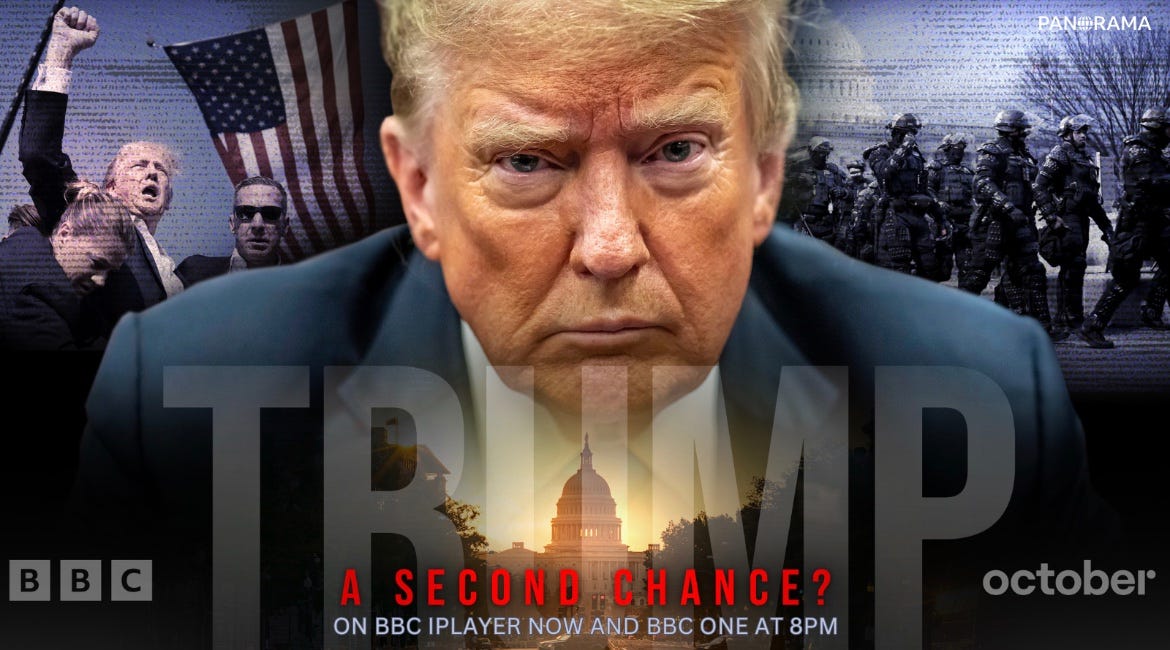
‘Fight like hell’: In the clip of Trump’s speech from Jan 6th, it looked like he said to the crowd: “We’re going to walk down to the Capitol and I’ll be there with you, and we fight. We fight like hell.”
But the thing is: The words were taken from different parts the speech, nearly an hour apart. They also removed a part where Trump said he wanted supporters “to peacefully and patriotically make your voices heard”.
Awkward: Have a look at the video yourself - courtesy of The Telegraph, with footage taken from BBC Panorama on the left, and the original clip on the right.
Clear cut? I didn’t watch the show when it went out, but I would certainly have assumed that was a clip of a single section of the speech. If it isn’t, then it should be clear that the two pieces have been edited together.
News flash: This whole saga could easily have been avoided with something like a ‘white flash’ at the cut point. I was a producer of TV news and current affairs programmes for a decade, and would regularly use editing techniques like this to signal to the audience that an edit has been made, and they are viewing non-contiguous sections of footage.
So to me this is pretty clear cut (excuse the pun) - and it will ultimately be hard for the BBC to defend over the coming days and weeks.
Here’s why:
1. ‘It’s the cover-up that’ll get you’
This scandal isn’t just about what was broadcast - it’s about what happened after that. The accusation is that concerns about the programme were raised internally by Michael Prescott, but not acted on. Do I think there was a ‘cover up’? No, but clearly there was a discussion, since Prescott refers to comments made by the Chief Executive of BBC News Deborah Turness and her deputy Jonathan Munro. So why was nothing done about it - e.g. re-editing the programme, or attaching a note for audiences while it was still available online? We should wait to see the full memo (and ideally the minutes from these meetings), but with only partial information at present, the BBC risks looking complacent at best.
2. This is about accuracy:
This isn’t a subjective debate about impartiality, with grey areas and different angles. It’s much more simple than that: the programme makers edited the Trump speech so that comments he made about ‘fighting’ were given a different context.
Mr Trump has said lots of things about the 6th January attacks, and those who were involved. That is not disputed here. But accuracy in news must be applied evenly. It’s not ok to be sloppy - or deliberately misleading - simply because the subject has said something similar - or worse - elsewhere. You can dislike Donald Trump fundamentally, but still feel that accuracy about what he says is vital. This isn’t about Trump - it’s about accuracy, and trust in the BBC.
3. This is internationally significant:
This couldn’t have have happened to a worse subject than the famously thin-skinned, mainstream media-hating President of the United States. It energises existing critics of the BBC over here - and activates new ones in the US. The President’s son has already lashed out on X:
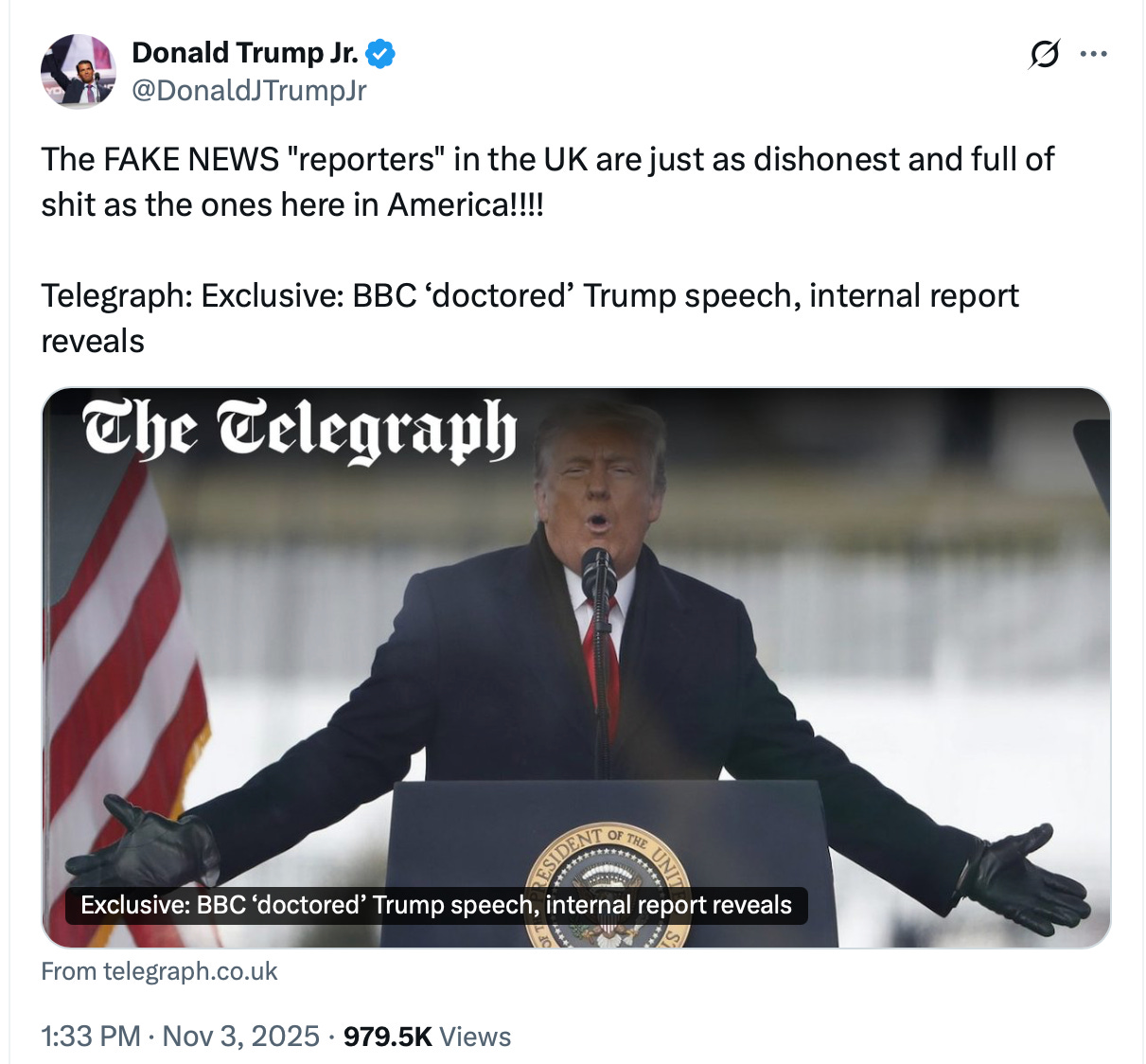
On the one hand it’s impressive that BBC News has sufficient profile in the US for the President’s son to complain about it (scuse his French) - but the downside of that is the risk that the BBC becomes a polarised presence there. Polling I commissioned earlier this year suggests this is already happening.
The research, from JL Partners, revealed a clear split in perceptions about BBC between Republicans and Democrats:
58% of Democrats thought BBC News was ‘very or somewhat trustworthy’ compared to 38% of Republicans.
And Republicans were three times more likely to believe BBC News to be ‘very untrustworthy’ than Democrats.
The BBC are currently trialling a new paywall in the US, which could make for bad timing from a commercial standpoint.
But the real significance of the global angle to this story will be felt much closer to home - in Downing Street. It’s not impossible to imagine this being raised by the US President in a call or meeting with Sir Keir Starmer - and at the very least, the Prime Minister will have been made aware of it and the potential embarrassment it could cause him. It’s one thing for the Prime Minister to defend a free media - it’s another for him to try to explain an error like this.
4. It plays into fears about AI and disinformation:
Increasingly we’re all questioning what we see online - and so regulated broadcasters play a vital role in maintaining trust through accurate news coverage. There’s lots of research (like this from the Reuters Institute) to show that trust in broadcast news is higher than other platforms. But that trust is fragile - and cannot be taken for granted. The clip in question hasn’t been ‘doctored’ and is not ‘false’ - but it’s still a video that risks misleading viewers contextually, and in that sense it is deeply unhelpful to the BBC’s overall efforts to counter disinformation. Just before the programme went out last year, the BBC launched this advert about its own efforts against disinformation efforts, titled ‘The fight for truth is on'.
What’s the response been to the story? Lots of people have waded in, including some usual suspects like Boris Johnson and Nigel Farage. But the fact that it’s about accuracy opens the BBC up to criticism on more fronts - so there has also been comment from Shadow Culture Secretary Nigel Huddleston (“These are extremely concerning revelations that could seriously undermine the brand and reputation of the BBC”) and Ofcom Chairman Lord Grade who has written to BBC Chair Samir Shah seeking reassurances that the issue will be investigated.
Curiously nothing from Culture Secretary Lisa Nandy yet unless I’ve missed it.
The Chair of the House of Commons Culture, Media and Sport Select Committee Dame Caroline Dinenage has also written to Mr Shah with a series of questions (to which she has demanded answers by Monday).
🍿Plus, her Committee have just announced that they will hold an evidence session with Michael Prescott next week.
So what now? At the moment the BBC are facing incoming on this from the media, from MPs and from Ofcom, with more to come. In comms terms, they are not in control of the story - but sooner or later they will be forced to announce some sort of investigation into this, so why wait? At the very least, that would allow them to point to an ongoing review to take the heat out of the story for the time being - but it could also allow them to get more on the front foot.
The BBC gave this statement to the Telegraph: “While we don’t comment on leaked documents, when the BBC receives feedback it takes it seriously and considers it carefully. Michael Prescott is a former adviser to a board committee where differing views and opinions of our coverage are routinely discussed and debated.”
In my view, the version of the edited speech is hard to defend without at least a simple apology and an acknowledgment of the mistake.
But there are certainly some points worth flagging in the BBC’s defence:
Summarising a speech for TV news is very normal - and Mr Trump is known for going on a bit. I’ve edited speeches plenty of times for TV - and it’s often done at speed, soon after a speech has been given (or even while it’s still happening). But as above, there are ways of making those edits much clearer to audiences.
The programme went out over a year ago, and received no complaints. Either no one noticed, or no one cared - until now (except Michael Prescott). And there’s no doubt that mistakes happen in TV all the time - as do questionable bits of editing. But it’s what happens when those are brought to light, that’s important.
This documentary appears to have been a genuine attempt to understand the Trump phenomenon. The programme is annoyingly no longer available on the BBC iPlayer, but a review of film in the FT from last year said that “rather than being challenged by the documentary-makers, [Trump’s supporters] are given room to speak about the economic malaise and political disenchantment that have drawn them to Trump”. Hardly an anti-Trump stitch-up.
The BBC Chair has previously asked for a review into the BBC’s Editorial Guidelines and Standards Committee (to which Prescott was an advisor) - but we are still awaiting its findings.
It’s not as if Prescott’s claims were completely ignored. They were discussed - and disagreed with. That sort of internal debate is good and healthy in an organisation like the BBC. But it’s important for us to hear the arguments against Prescott’s accusations. Either the BBC considered the accusations, and dismissed them - in which case why? Or they realised there was an issue but failed to do anything about it - in which case, who is responsible for that?
The Telegraph have long had it in for the BBC - and it’s not surprising that they are the outlet with the story.
Bad timing: It all feels like quite a sticky wicket to me - made worse by the fact that the Government will shortly launch the BBC Charter Review, which will put the corporation further under the political spotlight, with big decisions over its future in the balance.
I should also point out that there are other accusations in the Telegraph story, including those about BBC Arabic, and that the Panorama documentary also misled viewers about the timing and interaction between the speech and the arrival of three hundred ‘Proud Boys’ at the Capitol on 6th January 2021.
Given The Telegraph is behind a paywall, there is a helpful video on YouTube that talks through the story.
Tune in to Michael Prescott’s evidence at the Select Committee next Wednesday at 10am here.
📺 What to watch
The Girlfriend (Amazon Prime)
This twisty new thriller on Prime is a great binge watch. It’s slick, tense, and a digestible six episodes (perfect for a long flight).
Sure, some of the twists you can see coming, but that doesn’t make it any less addictive. It’s one of those shows you start thinking you’ll just give it a go, and suddenly it’s midnight and you’ve inhaled the whole thing.
It also stars Robin Wright, and features some great interiors - need I say any more?! It’s gripping - a bit predictable - but totally moreish.
Thank you to Johnny Moore for recommending it. Please keep your recommendations coming!
Martin Townsend
My colleague, friend (and loyal ScreenPower reader) Martin Townsend passed away last month. Martin was a top rate hack turned PR, having edited OK Magazine and the Sunday Express (for 17 years!) before joining us at Pagefield where we all loved him. There’s a great obituary for him here in The Times. He had so many fascinating stories from his time in journalism, and always had a great perspective on the stories of the day. He loved TV, and was very encouraging to me when I started this newsletter. He also loved a debate about the BBC - so he would certainly have had views on today’s story. This one’s for you MT ;)
That’s all for this week
Thank you for reading ScreenPower. As ever, do get in touch with any comments or questions on the topics covered in this issue, either by replying to this email or by connecting on LinkedIn.
And if you know someone who might enjoy this newsletter - why not forward it to them? It’s free!